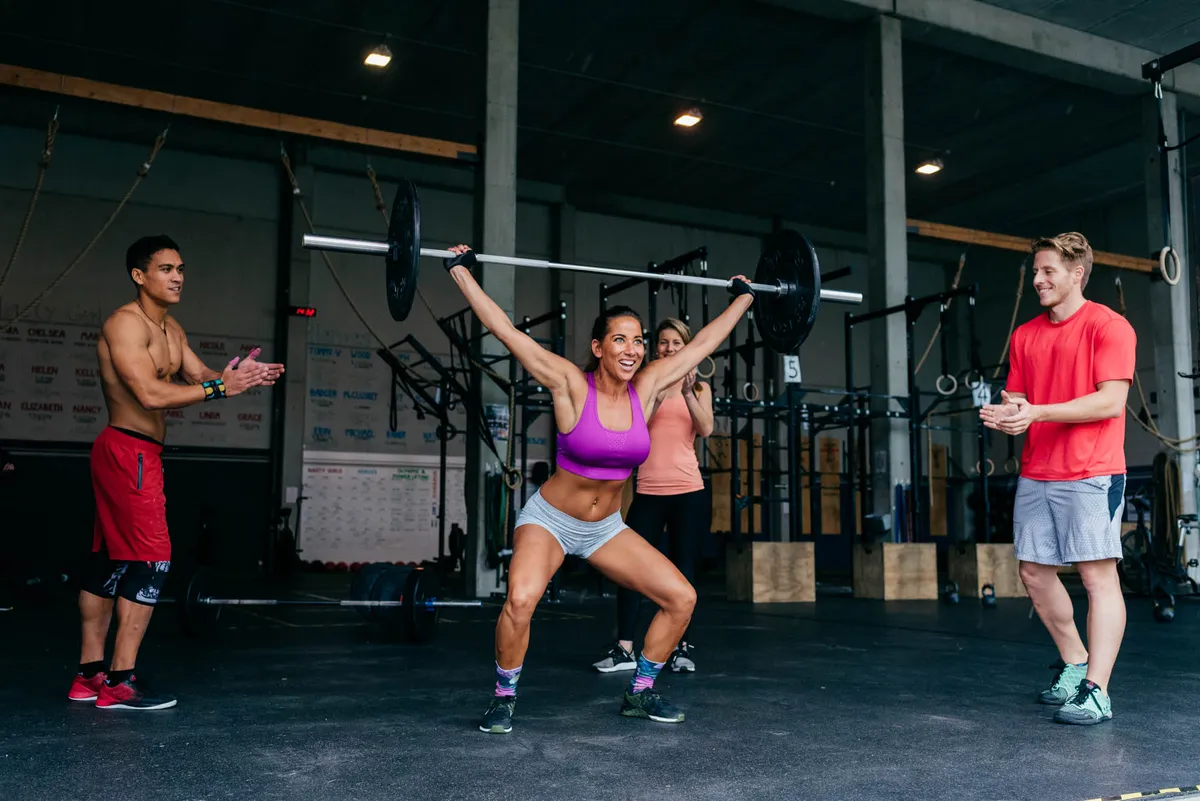
You've been at the box for a few months now. You enjoy the classes, the WODs give you that adrenaline rush you were looking for, and you've already got a few PRs to celebrate. But a question starts buzzing: "Should I follow a program?" And right after: "But which one?" You're not alone. It's one of the most common questions we hear, and the answer is never straightforward.
Table of contents
Group classes or individual program?
Box classes are probably the best starting point for anyone. A coach who's present, a group that pushes you, the variety of WODs exposing you to different stimuli every day. For the first 6-12 months, for most people, that's more than enough.
The problem comes when you start noticing patterns. Your overhead squat stays stuck because you lack mobility. Your rowing times haven't improved in weeks. Pull-ups aren't coming. The class is designed for the group, not for your specific weaknesses.
That's when an individual program starts to make sense — not as a replacement for classes, but as a complement. The community remains the engine, the program becomes the turbo.
What to look for in a program
Not all programs are created equal, and the most popular one on Instagram isn't necessarily the right one for you. Here's what to evaluate:
- Suited to your level — A beginner doesn't need 5 sessions a week with double workouts. 3-4 well-structured sessions beat 6 improvised ones
- Clear progression — The program should build something over time, not be a series of random WODs. If every week seems independent from the last, that's a red flag
- Balance between strength and conditioning — A good program works on both, with dedicated phases. As we explain in our article on periodization, alternating focus is essential for progress
- Flexibility — The program should adapt to your life, not the other way around. If it requires 2 hours a day and you have 1, it won't work
Generic program vs structured program
The internet is full of free programs. Some are well made. Many aren't. The main difference between a generic program and a structured one lies in the building logic.
A structured program follows periodization: accumulation phases, intensification phases, deload weeks. Every session has a precise objective that fits into a bigger picture. It's not "the WOD of the day" — it's a piece of a puzzle that comes together over time.
A generic program often puts together exercises that "work" without any progression logic. The result? It works for the first few weeks, then progress stalls. And you wonder what you're doing wrong — when in reality, the program ran out of fuel.
The right question isn't "how much does it cost?" but "who wrote it, and why is each session built this way?" According to the CrossFit® methodology, variety is essential — but variety doesn't mean randomness. Every stimulus should have a purpose.
When the Competitor program is right for you
We often hear people say "I'm not strong enough for a Competitor program." That's a misconception. The Competitor program isn't just for those dreaming of the Games. It's for anyone who wants to work with more volume, more specificity and more structure than a standard class offers.
If you recognize yourself in at least two of these points, you could benefit from a program like our Competitor:
- You've been training consistently for at least 1 year
- You have specific goals — improve a lift, master a gymnastics movement, complete a benchmark in a certain time
- You want to compete — even locally
- You feel that classes alone aren't enough to keep improving
If none of these apply, there's no rush. Classes remain an excellent foundation, and you can always add targeted accessory work without following a full program.
How to combine a program with classes
One of the most common mistakes is trying to do everything: the morning class, the afternoon program, some extra work in the evening. The result? Overtraining within three weeks.
Here's an approach that works for most people:
- 3-4 classes per week for group work, variety and the community
- 2-3 program sessions to work on specific weaknesses
- 1-2 full rest days — and by rest we mean rest, not "light cardio"
The trick is not overlapping stimuli. If the program calls for heavy back squats on Tuesday, skip a class with front squats on Wednesday. Communicate with your coach — good coaches love knowing what you do outside of class.
If you want to figure out the right combination for you, our programs are designed to integrate with class work without creating conflicts.
Choosing a program isn't a permanent decision. You can try one for a cycle — 8 or 12 weeks — and evaluate. The progress you'll see won't just be physical: you'll gain a deeper understanding of your body, your limits and how to push past them with method, not brute force. And in the end, that's exactly what "virtuosity" means — doing the simple things extraordinarily well before chasing complexity.