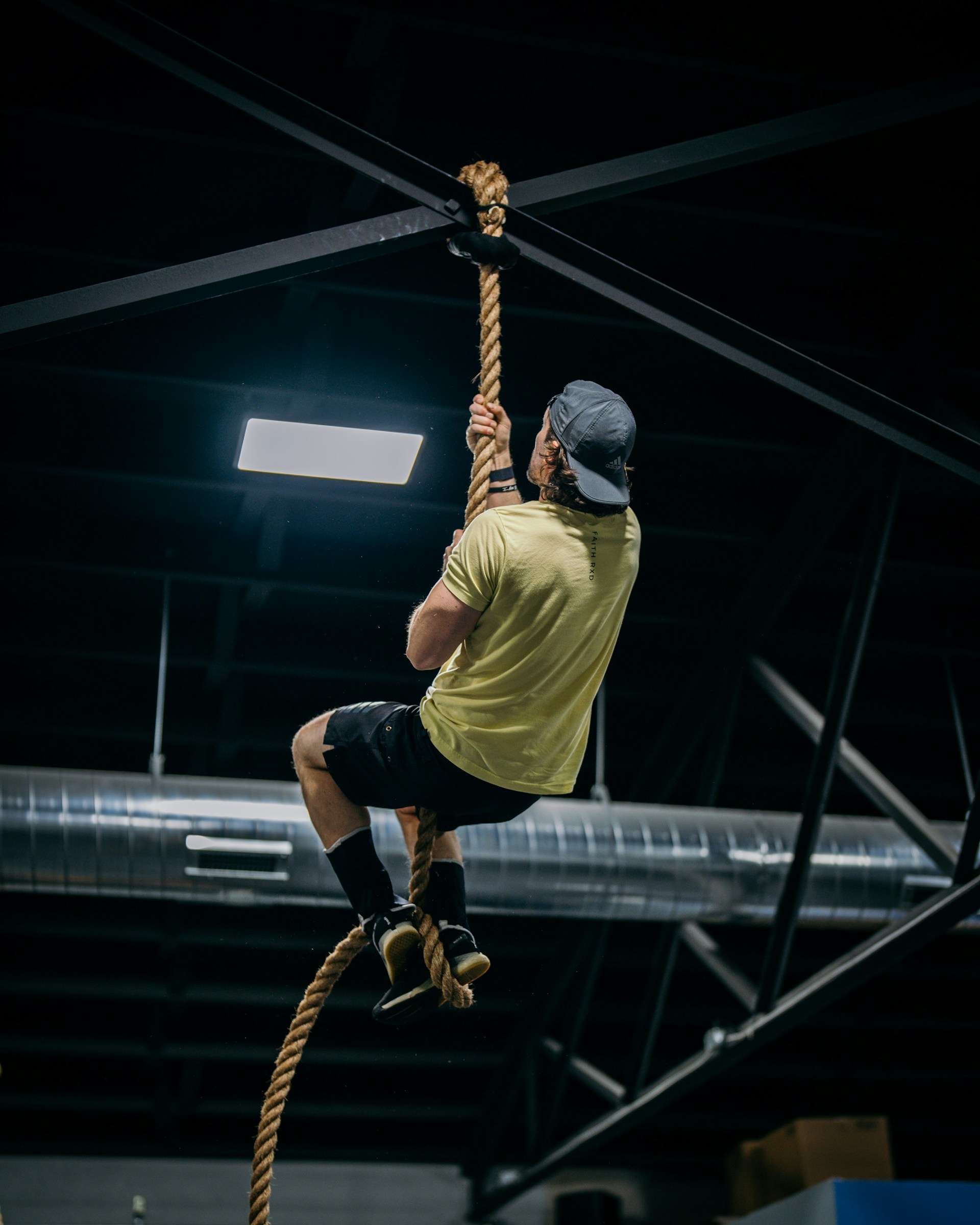
You look up at that rope hanging from the ceiling and feel your stomach tighten. You're not alone. The rope climb is one of those movements that exposes our insecurities — strength, coordination, and above all, self-confidence. But here's the truth: almost everyone can learn to climb the rope. It just takes the right approach.
Table of contents
Why the rope climb is scary
Let's start with something: being afraid of the rope is normal. It's not weakness, it's survival instinct. Your brain sees a 4-5 meter height, an unstable surface, and no solid handholds — and it screams at you to stay down.
The problem is that this fear makes you tense up. And when you're tense, you waste energy, lose coordination, and confirm to your brain that it was right to worry. It's a vicious cycle that breaks with only one thing: technical competence.
Those who climb fluidly aren't necessarily braver. They've simply automated the technique to the point where their nervous system trusts the movement. Your goal isn't to eliminate fear — it's to build enough competence to make it irrelevant.
Prerequisites to get started
Before throwing yourself at the rope, make sure you have the basics. You don't need impressive numbers, but some minimums are necessary to avoid unnecessary frustration.
Pulling strength: You should be able to do at least 3-5 strict pull-ups. If you're not there yet, focus on that first. The rope requires the ability to support and pull your body weight repeatedly.
Grip strength: Your hands need to hold the rope under load. If you struggle to hang for 30 seconds, work on dead hangs and grip strength.
Stable core: Rope climbing requires maintaining a compact position while coordinating arms and legs. A weak core means a swaying body that wastes energy.
You don't have to be perfect in all of this, but if you're completely lacking in any of these areas, start there. Skipping the fundamentals to try the rope will only lead to bad experiences that reinforce your fear.
Foot technique: the game-changer
Here's the point that changes everything: efficient rope climbing is not an arm exercise. It's a leg exercise. The arms mainly serve to stabilize and guide, but the drive comes from the feet.
The wrap and lock (J-hook):
This is the most common and safest technique for beginners:
- The rope passes on the outside of one leg, goes behind the calf
- Passes under the foot and comes up on the other foot
- The top foot presses on the rope, locking it against the bottom foot
- When the lock is solid, you can stand on the rope like a step
The Spanish wrap:
An alternative technique that some find more natural:
- The rope passes between the legs
- Wraps around one leg (from inside to outside)
- The foot of that same leg presses the rope against the shin of the other
Both techniques work. The key is to practice one until it becomes automatic. Don't switch techniques every week — confusion is the enemy of competence.
Progressions: from floor to ceiling
Never start on day one trying to reach the top. Smart progression builds confidence and competence together.
Phase 1: Seated foot lock
Sit on the ground with the rope in front of you. Practice the foot lock repeatedly until it becomes automatic. You should be able to do it without looking at your feet.
Phase 2: Standing foot lock
Standing, grab the rope above your head, lift your knees and practice the foot lock in the air. Then "stand up" on the rope and come back down. Repeat.
Phase 3: Two cycles
Once the foot lock is solid, try doing two complete cycles: grab, foot lock, stand up, grab higher, foot lock, stand up. Then descend with control.
Phase 4: Half rope
Go up to half the rope. Stop, look down (yes, this is important — you need to get used to the height), then descend with control.
Phase 5: Full rope
Only when the previous phases are fluid and safe, go for the full climb. And remember: touching the top is useless if you can't descend properly.
The descent: the forgotten art
Most rope climb injuries happen during the descent. And most hand burns too. Yet almost no one specifically practices descending.
Rule number one: NEVER let yourself slide. Every time you slide without control, you're teaching your nervous system a bad habit and risking serious burns.
The correct technique:
- Keep the foot lock active
- Lower your hands one at a time, with control
- Slightly release the foot lock
- Descend one "step" and retake the lock
- Repeat until you reach the ground
Yes, descending this way is slower. But it's also safe, builds eccentric strength, and allows you to do more climbs in a WOD because you're not destroying your hands.
Mistakes keeping you grounded
Some mistakes are so common I see them every week at the gym. Recognizing them is the first step to avoiding them.
Pulling only with arms: If your arms are blown up after one climb, you're doing it wrong. The legs should do 70-80% of the work. Go back to progressions and focus on the foot lock.
Looking up during the climb: Look at the rope in front of you, not the ceiling. Looking too high hyperextends the neck and throws off your balance.
Foot lock too low: If the foot lock is close to the floor when you climb, you need to raise your knees higher before locking. The higher the lock, the fewer cycles needed to reach the top.
Skipping progressions: I understand the rush to "reach the top," but skipping steps means building on shaky foundations. And sooner or later, shaky foundations collapse — usually at the worst moment, during an intense WOD.
Never practicing the descent: If you only practice going up, you're only practicing half the movement. Dedicate specific time to controlled descents.
The rope climb is one of those movements that separates those who have it in their arsenal from those who don't. But there's nothing magical about it — it's technique, practice, and patience. If you start from the right prerequisites and follow a sensible progression, in a few weeks you'll look at that rope with different eyes. Not with fear, but with the calm of someone who knows exactly what to do.
Want a structured program that includes progressive skill work for movements like the rope climb? Check out our programs — every session is designed to build real competence, one step at a time.