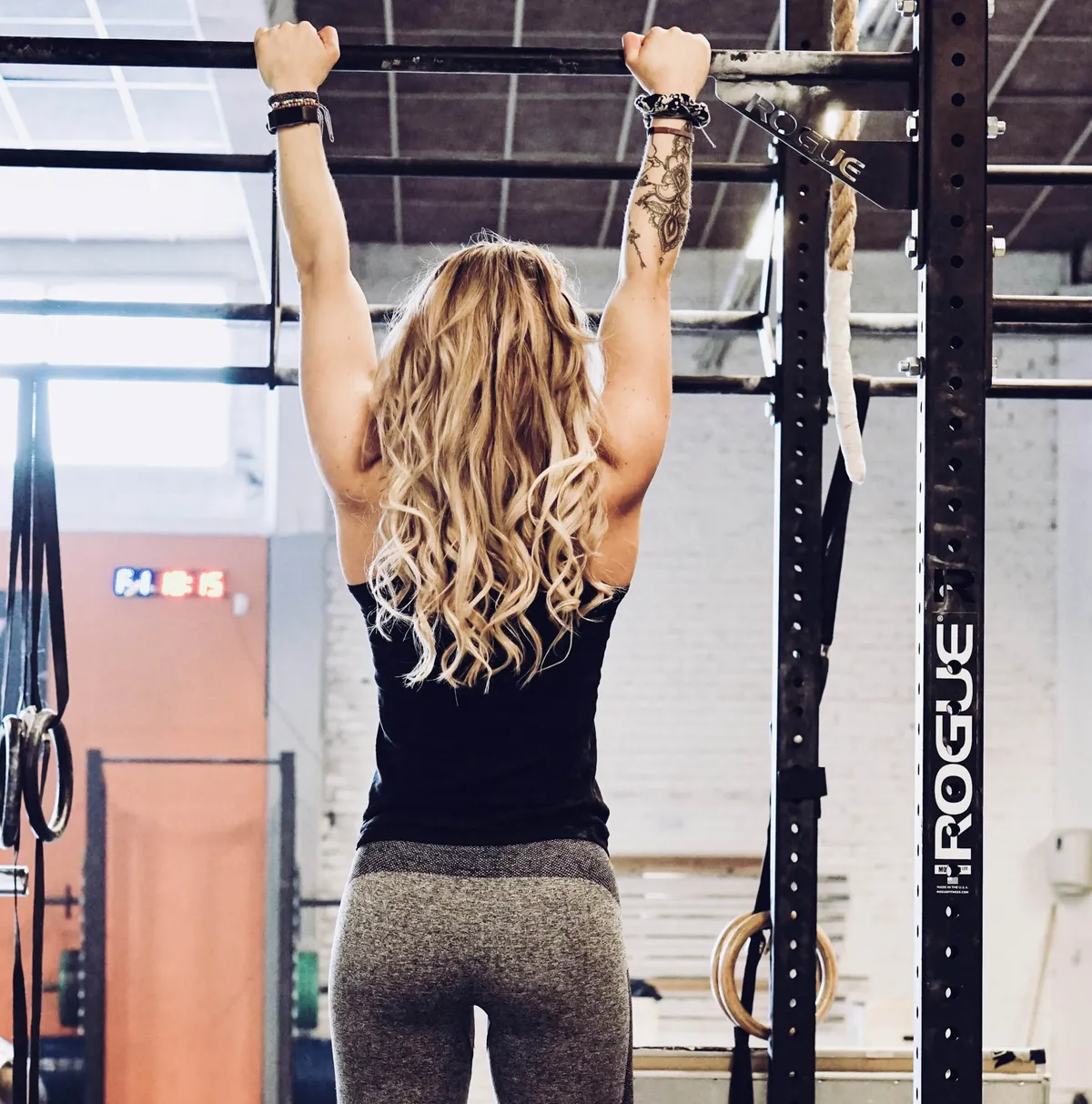
You grab the bar, pull with everything you've got, and... nothing. Your chin stays stubbornly below the bar. Or maybe you're on the other side: you can do your 5 strict pull-ups, but in a WOD with 50 reps you're dying after the first round. In both cases, the problem is the same: you're missing a structured progression. And no, "do more pull-ups" is not a strategy.
Table of contents
Strict vs kipping: two different movements
First things first: strict and kipping are not "easy" and "hard" versions of the same movement. They're different exercises with different goals.
The strict pull-up is pure strength. Starting from a dead hang, pulling until your chin clears the bar, with no momentum. It's the fundamental that builds upper body pulling strength. As we explain in our article about fundamentals, without this base everything else falls apart.
The kipping pull-up is a gymnastic movement that uses body swing to generate momentum. It allows you to do more reps in less time — perfect for WODs — but requires coordination, timing, and most importantly, a solid base of strict strength.
The most common mistake? Jumping straight to kipping because "it's easier." No. It's faster, not easier. And without the strength to control the movement, you risk injuring your shoulders.
Starting from zero: the strict basics
If you can't do a single strict pull-up yet, don't worry — that's where most people start. The good news: pulling strength builds relatively quickly if you know what to do.
Ring rows
Underrated by many, ring rows are the best preparatory exercise. They allow you to adjust difficulty simply by changing body angle: the more horizontal you are, the harder it gets.
- Start at a 45° angle and work towards being almost parallel to the ground
- Chest to ring level on every rep
- Keep your body rigid like a plank — no hips sagging
Negative pull-ups
Get up to the bar (with a box or jump) starting from the top position, then lower as slowly as possible. The eccentric phase is where strength is built.
- Goal: 5 seconds of controlled descent
- When you reach 8-10 seconds, you're probably ready for your first strict
- 3-4 sets of 3-5 negatives, 2-3 times per week
Dead hangs
Don't underestimate grip. Many people let go of the bar not because their back muscles give out, but because their hands open up. Work on your grip.
- Dead hang for time: start with 20-30 seconds, work up to 60+
- Active hang: from relaxed shoulders, engage the lats by "pulling" the scapulae down
- Alternate between overhand and underhand grip
Progressions for strict pull-ups
Once you have your first pull-up, the goal is to build volume. Here's how.
Grease the Groove method
Instead of doing a pull-up session to failure, do a few reps many times throughout the day. If your max is 3, do sets of 1-2 every hour. The idea is to accumulate volume without ever getting too tired.
Pull-up EMOM
An EMOM (Every Minute On the Minute) is perfect for building capacity:
- If you can do 5 pull-ups max: EMOM 10 minutes, 2 pull-ups per minute
- Progress by adding 1 minute each week, then increase reps
- When you can easily do 20 minutes, move to 3 reps per minute
Banded pull-ups
Bands are useful, but be careful: the band helps more at the bottom of the movement (where you're already stronger) and less at the top (where you need more help). Use them as a complement, not as a substitute for strength work.
As you improve, progress to thinner bands until you eliminate them completely. A structured program will help you manage this progression optimally.
When to move to kipping
Here's the rule we use: minimum 5 consecutive strict pull-ups before starting to work on kipping. Why?
- You need enough strength to control the swing
- Shoulders must be stable to handle the forces generated by the kip
- Without a strict base, kipping becomes a "yank" that loads joints and tendons
According to CrossFit® HQ, kipping is an advanced movement that requires mastery of the strict movement. It's not a shortcut.
Kipping technique
Kipping is based on the "kip swing" — the swing that generates momentum. Before pulling, you need to master the swing.
Kip swing drill
- Arch position: chest out, shoulders back, legs slightly behind vertical
- Hollow position: abs contracted, legs slightly forward, body in a "banana" shape
- Alternate between the two positions fluidly, using hips and shoulders
- Arms stay straight, you're not pulling yet
Pull timing
Once the swing is fluid:
- From hollow position, start the pull as hips return toward arch
- The hip "pop" toward the bar generates the drive
- Pull with arms while at the point of maximum acceleration
- Chin over bar, then controlled push-away to restart the cycle
Butterfly (advanced level)
The butterfly is an evolution of kipping that eliminates the "dead time" between reps. It's faster but requires even more control. Don't venture here until you have at least 15-20 consecutive kipping pull-ups with solid technique.
Common mistakes to avoid
Grip too wide or too narrow
The ideal grip is slightly wider than shoulder width. Too wide reduces useful range of motion, too narrow overloads the biceps and limits lat activation.
Chin "reaching" for the bar
I often see people extending their neck excessively to get their chin over the bar. This isn't a complete pull-up — it's a pull-up with compensation. Pull until your chest approaches the bar, not just your chin.
Kipping without descent control
The descent phase of kipping is where many people get hurt. Don't "fall" from the bar. The push-away must be controlled, shoulders must stay active. Remember: a good mobility routine before working on the bar is essential to prepare your shoulders.
Too much volume, too soon
Tendons adapt more slowly than muscles. If you go from 0 to 100 pull-ups per week, muscles might hold up but elbows and shoulders probably won't. Progress gradually and respect rest days. As we've seen discussing sleep and recovery, it's outside the gym that your body adapts.
Pull-ups are one of those movements that separate beginners from more advanced athletes. But there's no magic: just consistent work and smart progression. If today you can't do even one, in 3 months you could be doing 10. And those 50 pull-ups in the WOD that now seem impossible? They'll become just another round to complete. One step at a time, one rep at a time.